






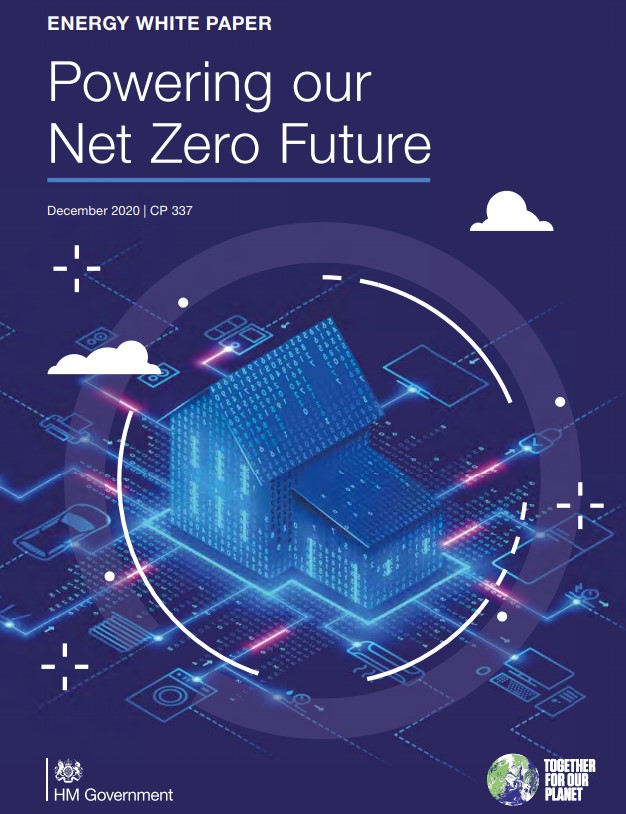
Energy White Paper presents Government plans to build back greener
Contents |
[edit] Introduction
The government has provided more detailed plans to ‘build back greener’ by boosting clean energy systems and green jobs in order to achieve net zero carbon emissions by 2050.
[edit] Key points
The Energy White Paper, published in December 2020, most notably commits to:
- Supporting up to 220,000 jobs in the next 10 years. This includes long-term jobs in major infrastructure projects for power generation, carbon capture storage and hydrogen, as well as a major programme of retrofitting homes for improved energy efficiency and clean heat.
- Transforming the UK’s energy system from one that was historically based on fossil fuels to one that is fit for a net zero economy, changing how we heat our homes and travel, doubling our electricity use and harnessing renewable energy.
- Generating emission-free electricity by 2050 with a trajectory that will see us have overwhelmingly decarbonised power in the 2030s. Low carbon electricity will be a key enabler of our transition to a net zero economy with demand expected to double due to transport and low carbon heat.
- Continuing to explore a range of financing options for new nuclear with developers. Given the scale of the financing challenge, we will also consider the potential role of government finance during construction, provided there is clear value for money for consumers and taxpayers.
- Delivering ambitious electricity commitments through commitment to deliver 40GW of offshore wind by 2030, including 1GW of floating wind, enough to power every home in the country – while attracting new offshore wind manufacturers to the UK.
- Kick-starting the hydrogen economy by working with industry to aim for 5GW of production by 2030, backed up by a £240m net zero Hydrogen Fund for low carbon hydrogen production.
- Investing £1.3 billion to accelerate the rollout of charge points for electric vehicles in homes, streets and on motorways as well as up to £1 billion to support the electrification of cars, including for the mass production of the batteries needed for electric vehicles. The rollout will support economic growth across the UK - including in manufacturing bases in the Midlands and the North East - while supporting the 169,000 jobs in our world-leading automotive sector.
- The £2 billion Green Homes Grant announced by the Chancellor has been extended for a further year in the Ten Point Plan.
- Moving away from fossil fuel boilers, helping to make people’s homes warmer, whilst keeping bills low. By the mid-2030s we expect all newly installed heating systems to be low carbon or to be appliances that we are confident can be converted to a clean fuel supply
Business and Energy Secretary Alok Sharma said, “With this long-term plan, we are turning climate ambition into climate action - putting the UK firmly on the course to net zero to end our contribution to climate change as we build back greener.”
This article originally appeared on the ECA website under the headline, "Government plans to build back greener." It was published on 15 December 2020.
--ECA
[edit] Related articles on Designing Buildings
- Articles by the Electrical Contractors' Association (ECA).
- A zero-carbon UK by 2050?
- ECA calls on Government to reform and rebalance energy levies and avoid cost of living crisis.
- Decarbonising concrete in the UK.
- Get ready for green jobs and upgrade projects.
- National Retrofit Strategy v2 launches.
- Net zero and green jobs.
- Net zero carbon 2050.
- Net zero commitment will be required for government contracts.
- Net zero strategy: build back greener.
- Organisations prompt government to Build Back Green.
- Renewable energy.
- The Government's 10-point plan: what's missing?
[edit] External resources
- Gov.uk, Green White Paper.
Featured articles
Check out some of the best features and news from Designing Buildings as well as key stories from around the web.

Sir Edwin Lutyens: Britain's greatest architect? Book review.

CIOB publishes free template to help assess and manage risks.
ECA's reflections on Party Conference season

Burnham wants to be confident of winning before asking for a fresh mandate.
New Chief Construction and Scientific Adviser

Sergio Cavalaro, Professor of Infrastructure Systems at Loughborough University.
Building safety levy for England

CIAT publish estimator tool for members.

Water sector faces a growing crisis that could slow the delivery of vital infrastructure.
Undervaluing our industrial past

Heritage value changes as taste for building styles changes.
Changing expectations around competence and compliance

New information sheet from CIAT.
Grenfell investigation files passed to CPS

Angela Rayner apologises on behalf of the British state.

Electrical contractors need to understand the practical implications.

The real barrier to getting more value from digital technology.

Your guide to The Construction Reset at UKCW Birmingham.